
About GALERI
Introduction
The interlinked crises of climate change, loss of biodiversity, poor governance, growing inequalities, and social fragmentation are threatening our world. Many of these challenges are consequences of economic systems that do not prioritize sustainability and the wellbeing of people and our planet. There is an urgent need to put greater emphasis on tackling the root causes of these developmental and environmental challenges, as universally recognized through the adoption of the UN Sustainable Development Goals (SDGs), the Addis Ababa Action Agenda on Financing for Development, and the Paris Agreement on Climate Change.
In June 2023, under India’s G20 Presidency, G20 Development Ministers endorsed the “G20 High Level Principles on Lifestyles for Sustainable Development” (Varanasi Principles) for the advancement of the United Nations’ Agenda 2030 and its Sustainable Development Goals (SDGs). The endorsement was a call to redouble efforts to achieve the SDGs but also reflected a growing global awareness of the need for a new development paradigm based on economic growth that is environmentally sustainable and socially inclusive.
To build on the momentum generated by the G20 Development Ministers, the Global Alliance for Life Economies Research & Innovation (GALERI) was launched at the G20 Global Summit on the LiFE Economy: From Principles to Action (New Delhi, November 26-28), which brought together experts and practitioners from around the world to explore pathways to accelerate the emergence of economic systems that advance sustainable social and environmental objectives, foster equity between current and future generations, and enhance the well-being of all people and the planet (“Life Economies”).
Life Economies: A Pathway for Sustainable Growth and Development
Elements of Life Economies have steadily been emerging over the past few decades and today encompass a wide range of alternative economic approaches, such as Green Economy, Impact Economy, Doughnut Economics, and others.
Businesses are the building blocks of any economy, past and future. There is a broad consensus that the social and ecological goals enshrined in the SDGs can only be achieved with the engagement of the private sector, which creates nine out of ten jobs even in poor countries. Yet, today most businesses are designed first and foremost to maximize financial returns, often generating harmful social and environmental externalities that hamper, or even reverse, progress on the SDGs.
As Life Economies evolve, businesses are shifting from maximizing short-term profits to optimizing long-term benefits for the societies and the environment in which they operate. Over the past few decades, new models of “purpose-driven” or “for-benefit” enterprises have emerged, dedicated primarily to social and environmental objectives. In their pursuit of serving the common good, these enterprises have been supported by innovations in public policy, sustainable finance, sustainable production and consumption, impact measurement, and responsible management.
Every member of the G20, along with many other countries, including Colombia, Ethiopia, Ghana, Malaysia, the Philippines, Singapore, and Sri Lanka, has instituted some form of domestic policy framework facilitating for-benefit enterprises.
Advancing Policy Coherence through Life Economies
SDG Target 17.14 calls on all countries to enhance domestic and international policy coherence for sustainable development as an essential means of implementation of the SDGs. Some of the global responses to this call have resulted in considerable progress towards more sustainability in the current economic system. However, those efforts have often been disparate and insufficiently coordinated. To succeed, they need to incorporate the goals and objectives of Life Economies into policy making processes and institutions.
Aligning Development Finance with the SDGs Through Life Economies
Development finance by governments, international institutions, philanthropic organizations, or other providers of funds, must play a catalytic role in promoting Life Economies. As Life Economies grow, increasing amounts of investments will shift towards responsible corporate conduct and entrepreneurship, decent labor standards, clean technologies and energy sources, and sustainable consumption in all parts of the world. This shift will require policies that facilitate financial flows towards sustainable development objectives. Such policies may include:
-
Reforming the global financial architecture
-
Transforming trade and value chains
-
Building sustainable and resilient infrastructure
-
Scaling entrepreneurship and employment
-
Coupling technology and innovation with sustainable development
-
Boosting sustainable consumption and production
-
Promoting women-led development
-
Advancing people-centric and inclusive governance
-
Aligning development finance with the SDGs
-
Reversing climate change and biodiversity loss
-
Strengthening sustainable food systems
-
Expanding integrated and holistic health systems
-
Enhancing policy coherence for sustainable development
GALERI Activities
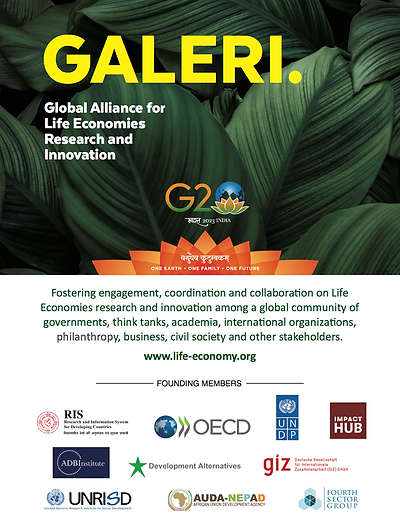
GALERI’s mission is to foster engagement, coordination and collaboration on Life Economies research and innovation among governments, think tanks, academia, international organizations, philanthropy, business, civil society, and other relevant stakeholders. GALERI’s activities may be divided into four areas:
-
Enhancing Knowledge & Understanding:
-
Identifying systemic obstacles to the development of Life Economies, such as restrictive policy frameworks or limitations on access to capital.
-
Supporting think tanks and researchers in conducting thematic studies on Life Economies in various countries, regions, and economic sectors.
-
Assisting countries in devising policies fostering the development of Life Economies.
-
Creating frameworks and standards for defining for-benefit enterprises and for identifying their contribution to achieving the SDGs; mapping best practices across countries and industries.
-
Developing a knowledge hub and thematic learning groups among stakeholders to share data, analyses, and initiatives relevant to the transformation towards Life Economies.
-
Establishing a monitoring and review system to track progress on global efforts to facilitate and accelerate the expansion of Life Economies.
-
-
Promoting Engagement & Dialogue:
-
Supporting dialogue and collaboration among decision makers in government, philanthropy, development finance institutions, international organizations and other development actors on the key challenges and pathways to enabling Life Economies.
-
Supporting subsequent G20 Presidencies and associated stakeholders in integrating Life Economies into the G20 agenda.
-
Mainstreaming Life Economies in global discussions on issues of sustainability (UNFCCC COPs, IMF/WB Spring and Annual meetings, UN General Assembly, UN Financing for Development Forum, G7, G20 and G77).
-
-
Facilitating Innovation:
-
Supporting global stakeholders in the development, coordination, implementation, and exchange of innovative approaches to the advancement of Life Economies.
-
Advancing innovative national and international regulatory and policy frameworks conducive to the expansion of the for-benefit enterprise sector.
-
-
Developing Capacity:
-
Developing a global Community of Practice to advance learning, collaboration, and action towards the development of Life Economies.
-
Creating capacities within governments to lead and monitor efforts to promote favorable ecosystems supporting for-benefit enterprises.
-
Members of the Alliance
The growth of Life Economies will have far-reaching implications on global and local questions of equity and the integrity of our planet. Accordingly, GALERI’s scope must be global in nature encompassing a multitude of stakeholders from all regions of the world working with a common purpose towards shared objectives:
-
Think tanks and academic research and policy institutions
-
Governments
-
Development practitioners
-
Civil Society organizations active in areas of development
-
Multilateral Development Institutions
-
Philanthropies
-
Industry and Business
Founding members of GALERI include:
ADBI Institute, AUDA-NEPAD, Development Alternatives, Deutsche Gesellschaft für Internationale Zusammenarbeit (GIZ); Fourth Sector Group; Impact Hub Network; The Organisation for Economic Co-operation and Development (OECD); Research and Information System for Developing Countries (RIS); United Nations Development Programme (UNDP); and United Nations Research Institute for Social Development (UNRISD).
Funding
GALERI’s mandate and activities require resources to organize events, conferences, workshops, to interact with governments and international organizations, to conduct case studies, or to cooperate with local communities and grass-root organizations. It is proposed that funding be broad-based and come from a variety of stakeholders, including multilateral bodies and financial institutions, governments, industry and business, and philanthropies.
Inclusivity and Localization
Developing Life Economies is based on collaboration with partner countries and the inclusion of the priorities of local communities. Thus, it requires investment in strengthening local capacity and in forging partnerships with local actors. GALERI shall support governments in upholding their commitments to inclusion and localization and help coordinate their efforts through exchanges of information on processes, activities, and achievements and shortcomings with all stakeholders concerned, including women, youth, and those marginalized by the current economic paradigm.
Our coasts and beaches are irreplaceable. Let’s save them.
Our Mission
I'm a paragraph. Click here to add your own text and edit me. It’s easy. Just click “Edit Text” or double click me to add your own content and make changes to the font. Feel free to drag and drop me anywhere you like on your page. I’m a great place for you to tell a story and let your users know a little more about you.
This is a great space to write a long text about your company and your services. You can use this space to go into a little more detail about your company. Talk about your team and what services you provide. Tell your visitors the story of how you came up with the idea for your business and what makes you different from your competitors. Make your company stand out and show your visitors who you are.
Our Vision
I'm a paragraph. Click here to add your own text and edit me. It’s easy. Just click “Edit Text” or double click me to add your own content and make changes to the font. Feel free to drag and drop me anywhere you like on your page. I’m a great place for you to tell a story and let your users know a little more about you.
This is a great space to write a long text about your company and your services. You can use this space to go into a little more detail about your company. Talk about your team and what services you provide. Tell your visitors the story of how you came up with the idea for your business and what makes you different from your competitors. Make your company stand out and show your visitors who you are.